You check your bank account and see $900. The tempting conclusion is simple: you have $900 available.
But if $420 in bills still has to come out before payday and you need another $200 for groceries, gas, and ordinary life, spending based on the $900 balance can put you in trouble fast.
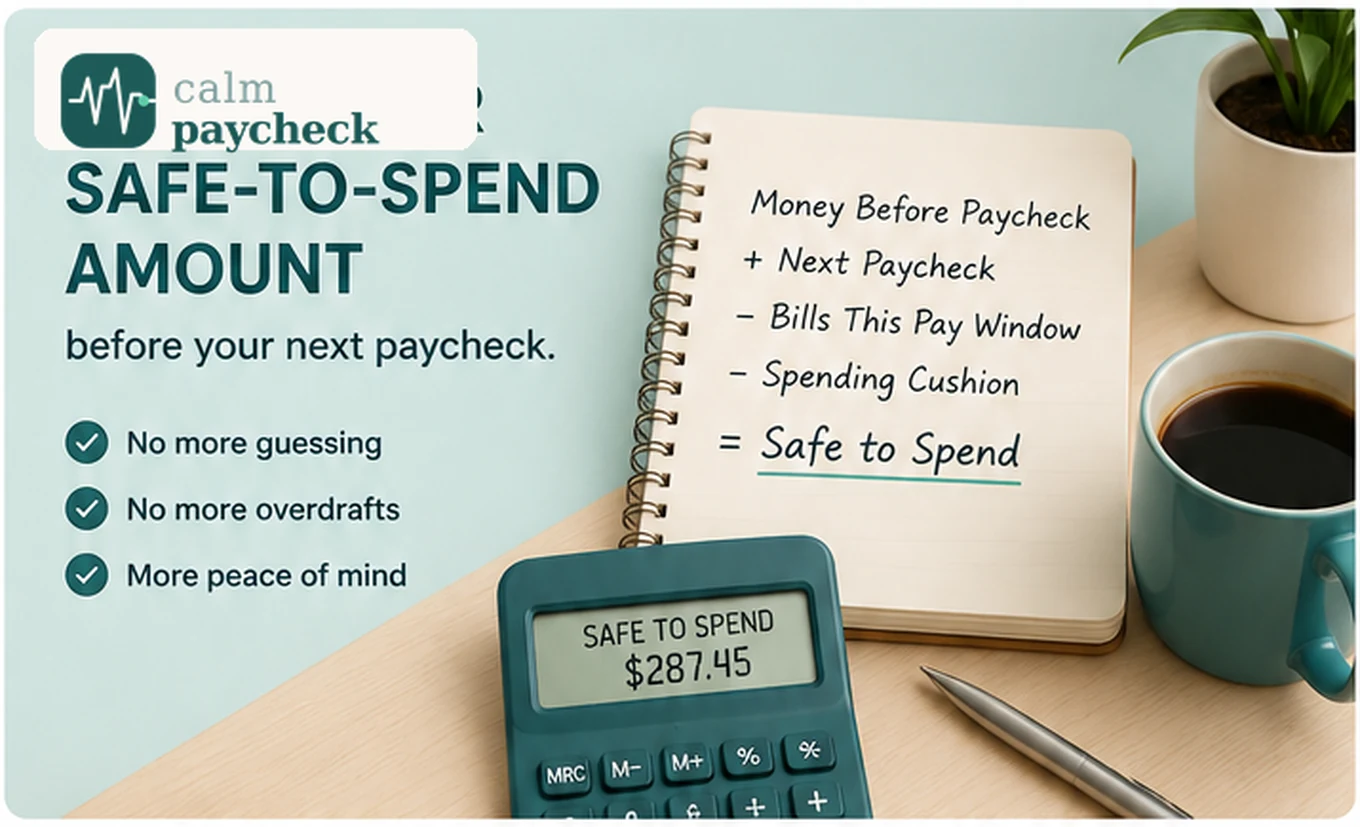
The simple safe-to-spend calculation
The calculation is straightforward:
The important part is not the arithmetic. It is making sure you subtract the money that already has a job before you decide what is available for anything else.
Step 1: Start with the money available for this pay window
Begin with the money you actually have to work with during the period between now and your next paycheck.
For many people, that means the balance available at the start of the pay window plus the paycheck that just arrived. The exact starting point matters less than being consistent and not counting money twice.
If you are using CalmPaycheck, this is handled through Money Before Paycheck plus the current paycheck amount.
Step 2: Subtract the bills due before your next paycheck
Now look only at bills that must be paid before the next payday. Do not let the calendar month distract you.
- Rent or mortgage
- Utilities
- Insurance
- Minimum debt payments
- Subscriptions and autopay charges
- Any other scheduled expense due before the next paycheck
A bill due after the next paycheck belongs to a later pay window. A bill due before the next paycheck belongs to this one.
Step 3: Reserve a realistic spending cushion
Bills are not the only money you will spend before payday. You still need groceries, gas, medication, household basics, and room for ordinary life.
That is why the calculation needs a spending cushion.
If you normally spend around $100 per week on variable essentials and payday is two weeks away, a $200 cushion is more realistic than pretending those expenses will somehow be zero.
Step 4: What remains is the useful number
After subtracting bills and your spending cushion, what remains is much closer to the amount you can safely make decisions with.
Example
- $900 money available
- − $420 bills due before payday
- − $200 spending cushion
- = $280 safer to spend
Your bank app still says $900 at the beginning. But the number that matters for spending decisions is closer to $280.
That difference is exactly why a healthy bank balance can still turn into an overdraft a few days later.
What if the answer is zero or negative?
That is useful information too.
If the calculation shows $0 or a negative number, the current pay window is already fully committed. The goal is not to make the number look better. The goal is to see the situation early enough to make a different decision.
You may need to postpone optional spending, move a flexible expense, reduce the spending cushion temporarily, or decide which bill needs attention first.
Why the next paycheck matters more than the end of the month
Suppose your paycheck arrives on September 4 and the next one arrives September 18. Your immediate planning window is September 4 through September 17.
A September 25 bill does not need to come out of this paycheck if another paycheck arrives first. A September 12 bill does.
This is why budgeting between paychecks instead of by month can make the timing much easier to understand.
Your bank balance is still useful — just not as a spending number
Your checking balance is an important starting point. It becomes misleading only when you treat the entire amount as available to spend.
If this distinction is new, read Why Your Bank Balance Isn't Your Safe-to-Spend Balance. The basic idea is that some of the money in your account already belongs to future obligations.
A five-minute version you can do without a spreadsheet
Take a piece of paper and write down four numbers:
- Money available now
- Total bills due before the next paycheck
- A realistic spending cushion
- What remains after subtracting #2 and #3 from #1
That fourth number is the one to pay attention to before making an optional purchase.
If you want a simple walkthrough, the free 5-Minute Safe Until Payday Checklist uses this exact process.
Use the free checklist to separate the money in your account from the money that is actually available before your next paycheck.
Get the free checklistWhere CalmPaycheck fits
Doing this calculation once is easy. Doing it repeatedly while paydays, bills, overdue items, and month boundaries move around is where people start losing track.
CalmPaycheck is designed to automate the pay-window calculation. You enter your paydays, paycheck amounts, bills, weekly spending cushion, and Money Before Paycheck. It identifies the current pay window and shows what is left after the bills and spending cushion that matter before the next payday.
You can also see How Much Money Is Safe to Spend Until Payday? for another practical example of the same idea.
Frequently asked questions
How do I calculate what I can spend before my next paycheck?
Start with the money available for the current pay window. Subtract bills and scheduled charges due before the next paycheck, then subtract a realistic spending cushion. What remains is your safer-to-spend amount.
Should I use my full bank balance as my spending amount?
No. Your bank balance may include money that is already needed for bills, subscriptions, groceries, gas, and other expenses before payday.
What is a spending cushion?
It is money deliberately reserved for everyday spending before the next paycheck. It can cover groceries, gas, household needs, medications, and similar ordinary expenses.
Does this work if I am paid every two weeks?
Yes. The method works especially well for biweekly pay because it focuses on the actual period between paychecks rather than forcing every paycheck into a calendar month.
The bottom line
Before asking, “Can I afford this?” start with a better question:
Subtract those obligations and leave yourself a realistic spending cushion. What remains is a much more useful number than the balance displayed by your bank.
That is how you calculate what you can spend before your next paycheck.